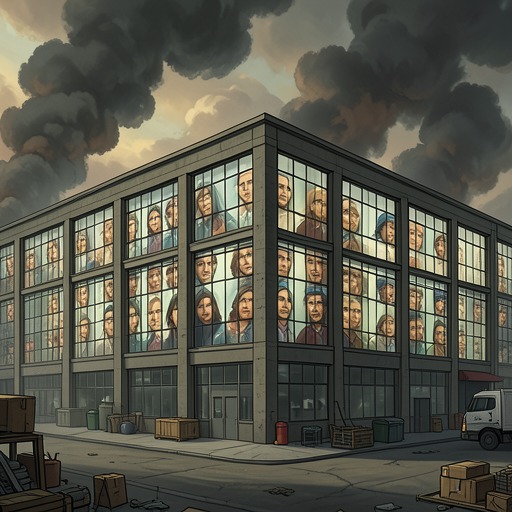
Community, Identity, Stability
Brave New World“Community, Identity, Stability” is the World State’s official motto and a concise statement of its political logic. Displayed above the entrance to the Central London Hatchery and Conditioning Centre, it joins collective order to standardized identity and presents stability as the purpose that makes both desirable. Across the novel, however, the words function not merely as a slogan but as a blueprint: biological production, psychological conditioning, social expectations, and limits on knowledge all work to make a stable society feel natural and self-evident.
Motto and governing ideal
The motto appears on a shield above the Hatchery’s entrance, where the production of human beings makes its abstractions concrete. The Director calls Bokanovsky’s Process a major instrument of social stability: it can produce uniform batches of people suited to standardized work, including ninety-six identical twins operating ninety-six identical machines. The imagined ideal is mass production extended from industry into biology, with uniform Gammas, Deltas, and Epsilons supplying predictable labor. The motto’s “identity” therefore does not principally celebrate personal distinction; in this setting, it means assigning people their places within an ordered collective.
The Hatchery’s administration makes that order a matter of information as well as reproduction. As eggs move from test tubes into bottles, labellers transfer heredity, fertilization date, and Bokanovsky Group details, turning anonymous biological material into identified entries. An eighty-eight-cubic-metre card index is updated daily and coordinated so that Predestinators can calculate how many individuals of each quality are needed and the optimum rate of decanting. The Predestinators send their figures to the Fertilizers, who supply the embryos requested. The motto’s promise of stability is thus backed by a continuing system of measurement, allocation, and replacement, not left to chance or individual choice.
Making the motto feel like common sense
The State’s social order is sustained by instruction that shapes children’s judgments before those judgments can be experienced as independent. In an Elementary Class Consciousness lesson, a recorded voice teaches a Beta child to feel glad about the caste’s privileges and limits: Alphas are cleverer and work harder, while Gammas, Deltas, and Epsilons are described as inferior and marked by their clothing and capacities. The lesson does not merely identify social divisions; it trains children to take pleasure in their assigned position and to disparage those below them.
The Director describes the long effect of sleep-teaching through an image of drops of sealing wax that adhere and build up until the surface beneath them is covered. Suggestions from the State become the child’s mind and remain the adult’s mind: the very material from which a person judges, desires, and decides. Stability is consequently reproduced through consent as well as administration. The system’s most effective commands are made to feel like the subject’s own conclusions.
The same method turns social rules into unquestioned truths. The proverb that everyone belongs to everyone else is accepted as axiomatic after more than sixty-two thousand repetitions in the dark. The Controller sets this sexual norm against family, monogamy, romance, and exclusiveness, treating concentrated attachments as threats to the circulation of impulse and energy. Yet Lenina admits that she has not recently felt keen on promiscuity. Her hesitation registers a small distance between the rule and an individual feeling, even as the social ideal presses her to regard that feeling as an inconvenience.
Conditioning reaches beyond caste and sex into habits of consumption. Children are taught to love flying and new clothes, while repeated lessons insist that old clothes should be thrown away and that ending is better than mending. The Controller connects such habits to the conscription of consumption: citizens are governed by shaping what they want and what they consider normal to discard. The motto’s “community” is therefore also an economic arrangement, sustained by manufactured demand as well as coordinated labor.
Stability as a political argument
The Controller presents stability as civilization’s primal and ultimate need. His explanation gives the slogan its starkest rationale: industrial and demographic systems depend on wheels that keep turning, and those wheels require obedient people who remain content while tending them. He invokes the possibility of mass starvation if the machinery stops, setting social disruption against the suffering of a population unable to sustain itself. Stability is not offered as one value among many but as the condition upon which the society claims all its other benefits depend.
In defending caste labor, the Controller argues that the lower castes do not experience their work as oppressive. Their routine is described as light and simple, followed by soma, games, unrestricted sex, and Feelies. He says that a four-hour working day was tested across Ireland more than a century and a half earlier: extra leisure brought unrest and increased soma consumption rather than happiness. The State could reduce working hours, he argues, but refuses to impose what it considers excessive leisure. It also keeps a third of the population in agriculture despite the possibility of synthesizing every morsel of food, because production from the land takes longer and helps preserve stability. In this reasoning, people’s welfare is defined and managed by the regime, which treats change and unstructured freedom as risks.
The price of the ideal
The motto’s promise is finally measured against what the State suppresses to maintain it. In debate with John, the Controller argues that the stable world has no place for the social conditions that make tragedy possible. People receive what they want and do not want what they cannot have; they are protected from illness and fear of death, while passion, old age, parents, children, and lovers are kept from becoming powerful attachments. If anything goes wrong, soma is available. The claimed security depends on conditioning people into conduct that conforms to the system and making the means of escaping distress readily available.
John insists that Shakespeare’s Othello is better than the Feelies, and the Controller agrees that it is, but calls the sacrifice the price of stability. High art gives way to entertainment organized around agreeable sensation, because tragedy requires social instability. The same logic extends to science: even pure research is treated as potentially subversive, and the Controller says it must be kept chained and muzzled. Stability thus limits not only the forms of experience people may have, but also the knowledge through which they might question the arrangement.
The motto’s three terms work together, but not as neutral ideals. “Community” names an organized collective; “identity” is produced through caste, biological planning, and instruction; “stability” authorizes the interventions that keep both in place. The phrase’s polished balance conceals a hierarchy of values: order takes precedence over individual attachments, artistic achievement, scientific freedom, and the right to experience desires the State has not designed. Its force lies in making that exchange sound like a shared social good rather than a political choice.